Donald Trump: From the brink to a breather: Trump’s Iran pivot buys time, not trust
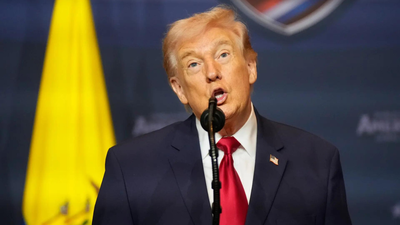
TOI correspondent from Washington: In a sudden pivot that pulled the world back from the precipice of an apocalyptic strike, the United States and Iran have entered a fragile two-week ceasefire after days of escalating strikes and threats, offering a narrow window for diplomacy to achieve Middle East peace amid residual mistrust and skepticism. The truce, announced by US President Donald Trump just two hours before his 8:00 PM deadline to “erase Iranian civilization,” marks a welcome — if chaotic — de-escalation in a month-long conflict that has seen global oil prices soar by 60% and the world economy getting increasingly edgy. Questions remain though about whether the ceasefire, stitched together through a mix of public signalling and backchannel contacts, is a genuine turning point or merely an interlude in a volatile confrontation.The contours of the ceasefire, as understood from official statements and diplomatic sources, are limited but significant. Predicated on a 10-point proposal drafted by Tehran, which Trump initially rejected as inadequate but now says forms a “workable basis” for talks to be held in Islamabad on Friday, it will see both sides halt direct military strikes and restrain allied or proxy forces for a 14-day period. Maritime activity in and around the Strait of Hormuz is expected to continue under heightened monitoring, with informal assurances against interference in commercial shipping. There is, however, no formal written agreement released publicly, and key details — including enforcement mechanisms and verification — remain opaque.The breakthrough came not from the United Nations or traditional European intermediaries, but through intense backchannel parleys by Pakistan, whose Prime Minister Shehbaz Sharif and army chief Asim Munir reportedly engaged US vice president JD Vance and Iranian foreign minister Abbas Araghchi to hammer out the tentative truce.“Based on conversations with Prime Minister Shehbaz Sharif and Field Marshal Asim Munir, of Pakistan, and wherein they requested that I hold off the destructive force being sent tonight to Iran, and subject to the Islamic Republic of Iran agreeing to the COMPLETE, IMMEDIATE, and SAFE OPENING of the Strait of Hormuz, I agree to suspend the bombing and attack of Iran for a period of two weeks. This will be a double sided CEASEFIRE!” Trump said in a social media post, positioning himself as a benevolent victor. Although he claimed that the reason he is agreeing for a ceasefire is that “we have already met and exceeded all Military objectives, and are very far along with a definitive Agreement concerning Long-term PEACE with Iran, and PEACE in the Middle East,” Trump acknowledged receiving a 10-point proposal from Iran, which he said “is a workable basis on which to negotiate.” “Almost all of the various points of past contention have been agreed to between the United States and Iran, but a two week period will allow the Agreement to be finalized and consummated,” he wrote. But that spin was countered by a statement from Iran issued through the Tasnim News Agency (the semi-official voice of the IRGC), the authenticity of which was contested by Trump. The statement, which congratulated the Iranian people on “forcing the criminal America to accept its 10-point plan,” described the truce as conditional and reversible, while warning that any violation would be met with “decisive response.” Trump dismissed the statement as “fraudulent” and “fake news put out by CNN,” while pointing to a statement from Iran’s foreign minister. Part of the confusion appears to stem from overlapping—and potentially divergent—signals within Iran’s own leadership. Statements attributed to its foreign ministry have struck a somewhat more conciliatory tone, emphasizing the importance of dialogue and hinting at readiness for structured talks. This has fueled speculation about a possible rift between Iran’s diplomatic apparatus and the more hardline clerical and security establishment that ultimately holds authority. The ceasefire’s diplomatic center of gravity now shifts to Islamabad, where talks are scheduled for Friday. However, Pakistan’s role too has not been without controversy. Some commentators have suggested that Sharif and Munir effectively acted as “wingmen” for Trump, helping to broker a pause that allows the US President to step back from earlier threats without appearing to retreat under pressure. Critics point to the President’s previous warnings about overwhelming force—including rhetoric that invoked the destruction of Iranian civilization—as evidence of an overreach that necessitated a diplomatic off-ramp. In this reading, the ceasefire serves as a face-saving mechanism rather than a negotiated equilibrium. Social media posts showing the edit history of Sharif’s statement suggesting he was posting messages dictated to him spiced up the day’s developments.Trump surrogates reject such characterizations, insisting that the pause reflects strength and strategic discipline rather than concession. Yet the optics remain contested, particularly in light of growing commentary around the so-called “TACO” label—“Trump Always Chickens Out”—circulating in political and media circles. While such jibes are not part of formal policy discourse, they underscore the domestic dimension of the narrative battle surrounding the ceasefire.
Poll
Do you believe the recent ceasefire between the US and Iran can lead to lasting peace in the Middle East?
Israel’s position adds another layer of complexity. Officials in Israel have not publicly opposed the ceasefire, but neither have they unequivocally endorsed it, while signalling a cautious acceptance contingent on the pause not constraining their ability to act against perceived threats. At the heart of the upcoming talks in Pakistan are several unresolved issues that will determine whether the ceasefire can evolve into something more durable. These include the scope of sanctions relief, the future of Iran’s nuclear program, the role of regional proxies, and security guarantees for maritime traffic. Diplomats will be watching for signs of coherence in Iran’s negotiating position, particularly whether the foreign ministry’s tone aligns with that of the broader leadership.