Inside the MQ-9 Reaper: How America’s armed drones reshape regional security
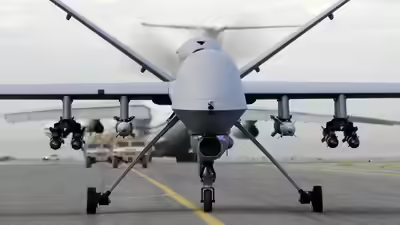
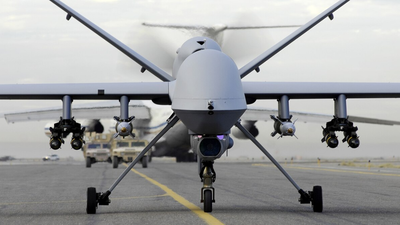
The United States is steadily expanding the deployment of its MQ-9 Reaper drones across the Indo-Pacific, strengthening a surveillance and strike network that is reshaping regional military dynamics.The MQ-9 Reaper, developed by General Atomics, is a long-endurance, remotely piloted aircraft capable of both intelligence gathering and precision strikes. Since entering service in 2007, it has become one of the most widely used armed drones in the US arsenal and has featured in high-profile missions, including the 2020 strike that killed Iranian General Qassem Soleimani.
What makes the MQ-9 significant?
The MQ-9 can fly at altitudes of up to 50,000 feet and remain airborne for extended periods, providing persistent surveillance far beyond the range of many traditional aircraft. Powered by a turboprop engine, it has a maximum speed of about 480 km/h and can carry a mix of sensors, communications equipment and precision-guided munitions.Its versatility allows it to conduct intelligence, surveillance and reconnaissance missions while retaining the ability to strike targets if required. Unlike unarmed surveillance drones, the Reaper can detect, track and neutralise threats in the same mission cycle.A maritime-focused variant, the MQ-9B SeaGuardian, has been equipped with systems capable of dispensing sonobuoys used to detect submarines. This enables long-range over-the-horizon monitoring of underwater activity at lower cost compared to manned anti-submarine warfare aircraft.
Expanding deployments across the region
The US Marine Corps has stationed MQ-9s indefinitely at Kadena Air Base in Okinawa, Japan, supplementing drones already operated there by the US Air Force. From Okinawa, the aircraft can monitor vast stretches of surrounding waters and airspace.Another squadron has been deployed at Kunsan Air Base in South Korea, marking the first such placement on the Korean peninsula. In the Philippines, an MQ-9 squadron has been positioned at Basa Air Base to enhance maritime domain awareness.The growing footprint reflects Washington’s emphasis on persistent surveillance and intelligence sharing among allies.
Allies acquiring the platform
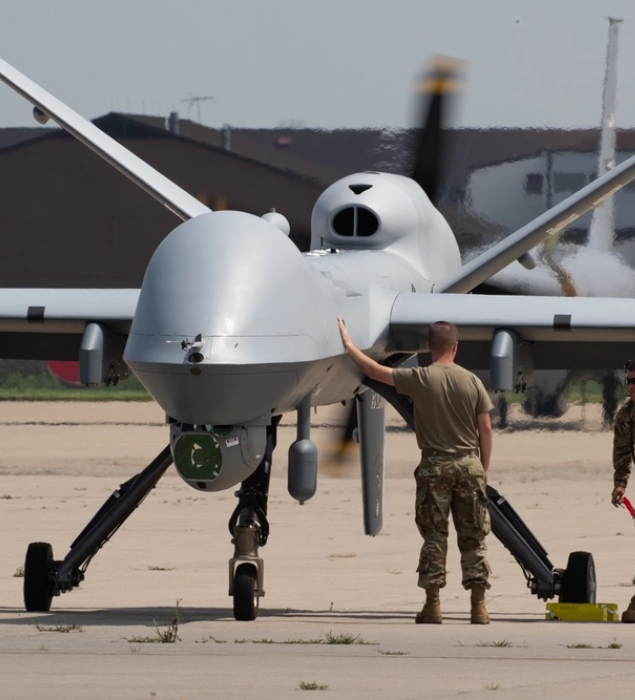
An increasing number of US partners are also procuring MQ-9 systems.Japan plans to expand the use of MQ-9B drones within its coast guard and maritime self-defence forces over the coming years. Taiwan has ordered MQ-9Bs, with initial deliveries expected soon. India has acquired MQ-9B drones and placed a large follow-on order valued at billions of dollars, with deliveries scheduled toward the end of the decade.The spread of the platform across multiple countries enhances interoperability. Shared data links, satellite communications and common operating systems allow near real-time exchange of surveillance data during joint exercises or coordinated operations.
How the drone fits into modern warfare
The MQ-9’s strength lies in endurance, sensor reach and networked warfare capabilities. It can relay targeting data to ships, aircraft or ground units, acting as an airborne node in a broader intelligence architecture.Analysts note that while the drone is primarily used for surveillance, it can carry precision munitions including air-to-ground missiles. Its ability to remain on station for long periods makes it particularly effective for maritime monitoring and tracking slow-moving or submerged targets.At the same time, the MQ-9 is not invulnerable. It is propeller-driven and slower than fighter jets. In multiple conflict zones, including Ukraine and Yemen, Reapers have reportedly been shot down. Military experts say air-defence missiles, electronic warfare systems and radar jamming can be used to counter such drones.
Strategic implications
The expansion of MQ-9 deployments is part of a broader US effort to strengthen intelligence cooperation and build a networked surveillance grid with regional partners. The emphasis is on persistent monitoring, rapid information sharing and the ability to respond quickly to emerging threats.For Beijing, the widening presence of high-altitude, long-endurance US drones and their integration with allied systems adds pressure to enhance counter-reconnaissance and air-defence capabilities. At the same time, analysts caution that managing drone operations in sensitive air and maritime spaces requires careful calibration to prevent incidents from escalating.As unmanned systems become more central to military planning, the MQ-9 Reaper stands out as a symbol of how modern warfare increasingly revolves around control of information, endurance in the skies and the integration of allies into a common surveillance network.